Rental Payment Reconciliation: A Property Manager's Guide
Discover what is payment reconciliation rental in property management. Ensure accurate finances, protect owner trust, and avoid costly surprises.
Rental Payment Reconciliation: A Property Manager’s Guide

Payment reconciliation in rental management is the process of verifying that every rent payment collected matches the corresponding lease terms, tenant ledger entries, and bank deposits exactly. It confirms that what you charged, what tenants paid, and what your accounting records show all tell the same story. For property managers overseeing 10 to 200 units, this monthly discipline separates clean financials from costly surprises. Get it right, and you protect owner trust, pass audits without stress, and close each month with confidence.
What is payment reconciliation in rental management?
Rent roll reconciliation is a structured monthly check confirming that the rent roll reflects lease requirements and recorded transactions. It is not an audit. It is a proactive control that catches errors before they compound into bigger problems. The industry standard is to complete this process before closing each accounting period.

The core purpose is straightforward: your rent roll lists what every tenant owes. Your general ledger records what has been collected and posted. Reconciliation confirms these two sources agree. When they do not, you have a discrepancy that needs investigation and correction before the books close.
Three records must align for a clean reconciliation:
- The rent roll: expected charges per lease for each unit
- The tenant ledger: individual payment history and account balances
- The bank statement: actual deposits cleared in the period
Any gap between these three records signals an error, a timing difference, or a missing transaction. The goal of rental income reconciliation is to find that gap and resolve it before it affects owner distributions or financial reporting.
What does the rental payment reconciliation process involve?
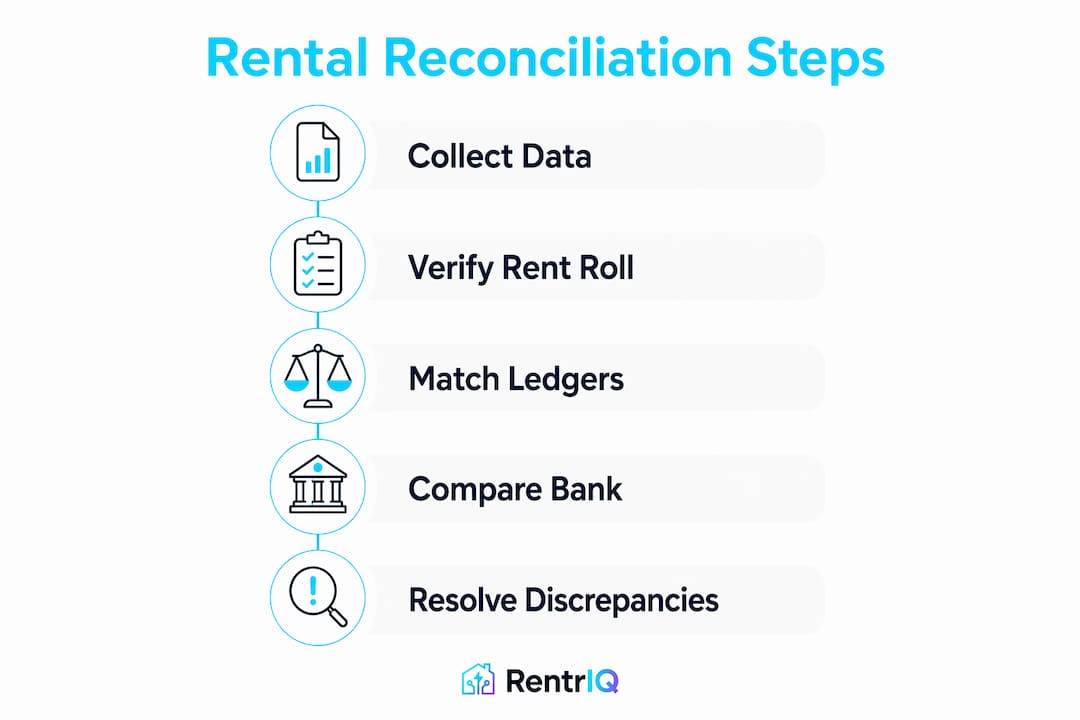
The monthly reconciliation workflow follows a clear sequence. Skipping steps creates gaps that are hard to trace later.
-
Prepare your rent roll data. Pull the current rent roll showing every unit, the lease rate, and any scheduled charges for the period. Confirm lease start and end dates are current and that any rent escalations or concessions are reflected correctly.
-
Run the tenant ledger report. Export each tenant’s account showing charges posted, payments received, and the running balance. Compare this against the rent roll line by line.
-
Match payments to bank deposits. Every payment recorded in the tenant ledger should correspond to a cleared deposit in the bank statement. Unmatched items are your first red flag.
-
Investigate variances. A variance is any amount where the ledger and bank do not agree. Common causes include payments posted to the wrong tenant account, deposits recorded in the wrong period, or payments still in transit.
-
Correct and document. Post correcting journal entries for any errors found. Document what the error was, why it occurred, and how it was fixed. This documentation protects you during owner reviews and regulatory audits.
-
Close the period. Once all variances are resolved and the three records agree, lock the period so no retroactive changes can create new discrepancies.
Pro Tip: Run your reconciliation on the same day each month, ideally within the first five business days after period end. Consistency makes errors easier to spot because you develop a feel for what “normal” looks like in your portfolio.
Correcting divergences promptly prevents reputational damage and costly audits. A discrepancy left unresolved for two months becomes exponentially harder to trace because new transactions layer on top of the original error.
What are the common challenges and errors in rental payment reconciliation?
Reconciliation errors fall into predictable categories. Knowing them in advance lets you build checks that catch them before they reach the owner report.
-
Misposted payments. A tenant pays $1,500 and the payment is applied to the wrong unit or the wrong charge type. The bank deposit matches, but the tenant ledger shows an incorrect balance. This is the most common manual entry error.
-
Timing differences. A tenant pays on the last day of the month via ACH. The bank does not settle the deposit until the second business day of the following month. Your ledger shows the payment in one period; your bank statement shows it in the next.
-
ACH returns. ACH returns can arrive up to 60 days after the original transaction. A payment that appeared clean in january may reverse in march, creating a negative balance that requires a clawback in the next cycle. Return rates in the 2%–5% range create significant manual exception handling for mid-sized portfolios.
-
Lease event errors. A rent escalation took effect on the first of the month, but the rent roll was not updated. You collected the old rate, posted it correctly, and the ledger and bank agree. But the rent roll shows a higher charge, creating a false variance.
-
Concessions and credits. A move-in concession or a maintenance credit applied to a tenant account reduces the expected payment. If the credit is not posted before reconciliation, the tenant looks delinquent when they are not.
-
Incomplete reconciliations. Running reconciliation only at year-end instead of monthly means errors compound for twelve months. Early correction prevents the kind of reputational damage that comes from presenting inaccurate owner statements.
Pro Tip: Build a simple exception log. Every time you find and fix a reconciliation error, record the error type, the unit, and the root cause. After three months, patterns emerge. You will know exactly where your process is weakest and can fix it at the source.
The consequences of unresolved variances extend beyond accounting. Owners receive inaccurate distribution statements. Tax filings reflect incorrect income. Regulatory audits expose trust account violations. None of these outcomes are recoverable without significant time and cost.
How does automated payment processing improve rental payment reconciliation?
Automated payment processing logs payments correctly with matching to property, tenant, and lease, enabling accurate reporting and payouts without manual re-entry. This single capability eliminates the most common source of reconciliation errors: human data entry.
The efficiency gains from automation create a chain reaction across your entire financial workflow:
- Payments post automatically to the correct tenant ledger the moment they clear, with no manual matching required.
- Lease data drives charge calculations, so rent escalations and concessions apply on the correct date without manual intervention.
- Bank feeds connect directly to your accounting records, flagging unmatched deposits in real time rather than at month-end.
- Failed payments and ACH returns trigger automatic alerts, so you address exceptions the day they occur rather than discovering them during reconciliation.
- Owner reports generate automatically from reconciled data, giving owners accurate statements without additional manual work.
The table below shows the difference between manual and automated reconciliation workflows across key performance areas:
| Area | Manual workflow | Automated workflow |
|---|---|---|
| Payment posting | Manual entry per transaction | Auto-posted on receipt |
| Error detection | Found at month-end | Flagged in real time |
| ACH return handling | Discovered during reconciliation | Alerted on return date |
| Month-end close time | 3–5 days | 1–2 days |
| Owner report accuracy | Dependent on manual review | Derived from reconciled data |
Choosing ACH over card payments is a critical financial decision that compounds these savings. ACH flat fees run under $1 per transaction. Card processing fees run approximately 2.9% plus $0.30 per transaction. On a $1,500 rent payment, that difference is roughly $43 per transaction. Across a 50-unit portfolio collecting monthly, the annual savings exceed $25,000. You can use Rentriq’s cash flow calculator to model exactly how payment method choices affect your net income.
Automation also improves audit readiness. Every transaction carries a timestamp, a payment method record, and a link to the originating lease. When a regulator or owner asks for documentation, you produce a complete audit trail in seconds rather than hours.
What is the difference between rent roll reconciliation and three-way reconciliation?
These two processes serve different purposes and operate at different levels of your accounting structure. Both are required for a fully compliant property management operation.
Rent roll reconciliation confirms that the charges on your rent roll match what is recorded in tenant ledgers and what cleared the bank. It is a transaction-level check focused on rental income accuracy. You run it monthly for every unit in your portfolio.
Three-way reconciliation is a trust accounting control. Three-way reconciliation ensures the bank balance, the general ledger liability, and the tenant and owner sub-ledgers all match exactly to the penny. Any variance indicates non-compliance and risks license discipline. This is the reconciliation that keeps property managers out of regulatory trouble.
The three-way reconciliation compares:
- Bank statement balance: the actual cash held in the trust account
- General ledger liability balance: what your accounting system says you owe to owners and tenants
- Sub-ledger totals: the sum of every individual owner and tenant account balance
All three must equal each other. If your bank shows $48,000, your general ledger shows $48,000, but your sub-ledgers total $47,850, you have a $150 discrepancy that represents either missing funds or a posting error. Neither is acceptable in a trust account.
Maintaining sub-ledgers in real time rather than reconstructing them at month-end prevents compounding errors and simplifies both reconciliation types. Errors become much harder to track when records are updated only during reconciliation. The best practice is to post every transaction the day it occurs, so your sub-ledgers always reflect current reality.
Rent roll reconciliation feeds into three-way reconciliation. If your rent roll reconciliation is clean, your trust account three-way reconciliation will be far easier to complete. The two processes are complementary, not redundant.
Key Takeaways
Rental payment reconciliation is the monthly process of matching rent roll data, tenant ledgers, and bank statements to catch errors before they affect owner reporting, compliance, or cash flow.
| Point | Details |
|---|---|
| Reconcile monthly, not annually | Monthly reconciliation catches errors early and prevents them from compounding across periods. |
| Three records must agree | The rent roll, tenant ledger, and bank statement must all match before you close a period. |
| ACH returns create delayed risk | Returns can arrive up to 60 days post-transaction and require active exception management. |
| Three-way reconciliation is a compliance requirement | Trust account three-way reconciliation is a regulatory standard; any variance risks license discipline. |
| Automation reduces manual error | Automated payment posting eliminates the most common source of reconciliation discrepancies. |
Why reconciliation discipline is the real differentiator
Property managers often treat reconciliation as a back-office chore. I have seen what happens when it gets deprioritized. A 40-unit portfolio running manual spreadsheets can accumulate six months of undetected posting errors before an owner asks a pointed question about their distribution. By that point, untangling the mess takes weeks and costs the relationship.
The managers who run clean portfolios share one habit: they treat reconciliation as a non-negotiable monthly deadline, not a task to complete when time allows. They also understand that real-time sub-ledger updates are not optional. Reconstructing records at month-end is where errors hide.
My strongest recommendation is to separate your payment method strategy from your reconciliation process. Choose ACH as your primary collection method for cost reasons, then build your reconciliation workflow around the timing characteristics of ACH settlement. Know that returns can arrive weeks later and build that exception check into your monthly routine.
The landlords who earn long-term owner trust are not the ones with the fanciest reports. They are the ones whose numbers are always right. Reconciliation discipline is what makes that possible. Pair it with a platform that automates the posting layer, and you remove the human error risk entirely. That combination is what separates a professionally managed portfolio from one that is just getting by.
— Stephen
How Rentriq supports accurate rental payment reconciliation
Property managers who want clean financials without the manual grind need a platform that handles the posting layer automatically. Rentriq connects online rent collection via Stripe directly to tenant ledgers, so every payment posts to the correct unit and lease the moment it clears.

Rentriq generates owner reports from reconciled data, maintains a full audit trail on every transaction, and flags failed payments immediately so you address exceptions before they affect your month-end close. The platform is built for portfolios of 10–200 units, which means you get the financial controls of an enterprise system without the enterprise price. Explore Rentriq’s property management tools and see how automated payment tracking changes what your month-end looks like. Check Rentriq’s pricing plans to find the right fit for your portfolio size.
FAQ
What is payment reconciliation in rental management?
Payment reconciliation in rental management is the process of verifying that rent charges, tenant payments, and bank deposits all match the general ledger and lease terms. It is a monthly control that catches billing errors, posting mistakes, and missing payments before they affect owner reporting.
How often should landlords reconcile rental payments?
Landlords should reconcile rental payments monthly, before closing each accounting period. Monthly reconciliation catches errors early and prevents them from compounding across multiple periods.
What is the difference between rent roll reconciliation and three-way reconciliation?
Rent roll reconciliation confirms that charges on the rent roll match tenant ledgers and bank deposits. Three-way reconciliation is a trust accounting standard that verifies the bank balance, general ledger liability, and all sub-ledger totals match exactly, which is a regulatory compliance requirement.
What causes payment discrepancies in rental reconciliation?
Common causes include payments posted to the wrong tenant account, ACH returns arriving weeks after the original transaction, lease escalations not updated in the rent roll, and timing differences between payment posting and bank settlement.
How does automation help with rental transaction reconciliation?
Automated payment processing posts each payment directly to the correct tenant ledger and lease without manual entry, reducing posting errors and accelerating month-end close. It also flags ACH returns and failed payments in real time, so exceptions are resolved before they affect reconciliation.
Recommended
Manage your rentals with RentrIQ
Free with unlimited units. Tenant screening, online rent collection, maintenance tracking, and more.
Start Free