Landlord Tax Deductions: Complete Guide for 2026
Every tax deduction available to rental property owners — depreciation, repairs, management fees, travel, home office, and more. With real examples.
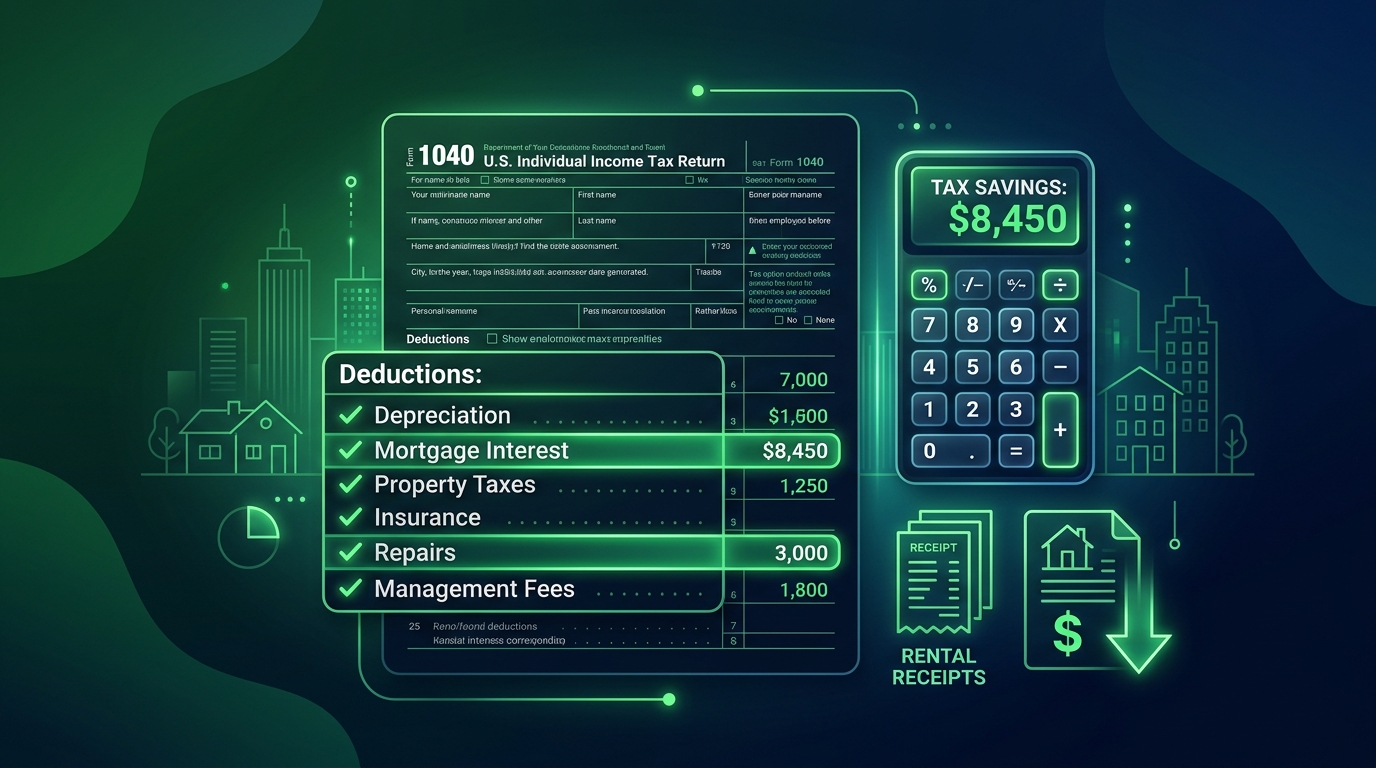
Most landlords pay more tax than they have to. Not because they're doing anything wrong, but because they don't know every deduction they're entitled to. Rental real estate is one of the most tax-advantaged investment vehicles available — but only if you track everything and claim what's yours. Here's the complete list for 2026.
1. Depreciation (Your Biggest Deduction)
The IRS lets you deduct the cost of the building (not the land) over 27.5 years for residential property. This is a non-cash deduction — you don't actually spend anything. On a $400,000 property where land is valued at $80,000, the depreciable basis is $320,000:
$320,000 ÷ 27.5 = $11,636/year in depreciation
At a 24% federal tax rate, that's $2,793/year in tax savings from an expense you never actually paid. Over 27.5 years, depreciation is your single largest deduction.
Cost segregation: For properties over $500,000, a cost segregation study can reclassify components (flooring, fixtures, landscaping) as 5, 7, or 15-year property instead of 27.5 years — dramatically accelerating deductions in early years.
2. Mortgage Interest
All interest paid on loans used to acquire or improve your rental property is fully deductible — even on refinanced loans if the proceeds were used for the rental. Keep your mortgage statements and 1098 forms. This is often the second-largest deduction after depreciation.
3. Property Taxes
State and local property taxes on your rental are fully deductible on Schedule E (unlike your primary residence, which faces the $10,000 SALT cap). If you have a property tax escrow account, deduct the amount actually paid out to the taxing authority in that tax year.
4. Insurance Premiums
Fully deductible: landlord/dwelling policy, liability umbrella policy, flood insurance, earthquake insurance. Your primary homeowner's insurance is not deductible, but your rental property's coverage is. If your policy covers multiple properties, allocate premiums proportionally.
5. Repairs and Maintenance
Ordinary and necessary repair costs are deductible in the year incurred. This includes: plumbing repairs, appliance repairs, paint touch-ups, HVAC servicing, pest control, landscaping, and cleaning between tenants.
Important distinction — repairs vs. improvements: A repair restores something to its original condition (replacing a broken window). An improvement adds value or extends useful life (replacing all windows with triple-pane). Improvements must be capitalized and depreciated over time, not deducted immediately. Getting this wrong is one of the most common audit triggers.
6. Property Management Fees
If you hire a property management company, their fees (monthly management fee, leasing fees, maintenance markups) are fully deductible. Even software subscriptions like RentrIQ that you use to self-manage qualify as a deductible business expense — more on software below.
7. Professional Services
Attorney fees (lease drafting, eviction proceedings, entity setup), CPA fees (tax preparation for your rental schedule), bookkeeper fees — all deductible. If your attorney or CPA handles both personal and rental matters, allocate the rental portion.
8. Advertising and Vacancy Costs
Zillow listing fees, professional photography, signage, online advertising, and any commissions paid to real estate agents for finding tenants — all deductible in the year paid, even if the vacancy runs into the next tax year.
9. Travel to Your Property
Business travel to your rental property for legitimate rental purposes (repairs, inspections, showing to prospective tenants, meeting contractors) is deductible. Two options:
- Standard mileage rate: $0.70/mile for 2026 (IRS updates this annually). Track your miles.
- Actual expense method: Deduct the proportional cost of gas, insurance, and depreciation on your vehicle for rental-related miles.
Out-of-town travel (flights, hotels, rental cars) to visit a property you actively manage is also deductible. Keep receipts and a log of the purpose of each trip.
10. Home Office Deduction
If you manage your rentals from a dedicated space in your home (a room used exclusively and regularly for your rental business — not a kitchen table), you can deduct a proportional share of your home's expenses: mortgage interest, property taxes, utilities, insurance, and depreciation of the home office space. Calculate it as: (home office square footage ÷ total home square footage) × eligible expenses. The simplified method allows $5/sq ft up to 300 sq ft.
11. Software and Subscriptions
Any software used in managing your rental business is fully deductible: property management platforms, accounting software, e-signature services, background check tools, and document storage. A RentrIQ subscription at $49–$199/month is fully deductible as an ordinary and necessary business expense. So is your CRM, your document storage, and your scheduling app if used for rental management.
12. Utilities (If Landlord-Paid)
Water, sewer, gas, electric, trash, and internet — if you pay these as a landlord (common in multi-family where water is shared), they're fully deductible. If utilities are split, only your landlord-paid portion is deductible. Keep utility bills organized by property.
Passive Activity Loss Rules: The $25,000 Allowance
Rental real estate income is generally classified as "passive" — meaning losses can only offset passive income, not your W-2 salary. Exception: If you actively participate in managing your rentals (approving tenants, deciding on repairs, setting rents) and your adjusted gross income is below $100,000, you can deduct up to $25,000 in rental losses against your ordinary income. This allowance phases out between $100,000 and $150,000 AGI.
For higher earners or those with large portfolios, consult a CPA about qualifying as a Real Estate Professional under IRC Section 469 — which allows unlimited passive loss deductions but requires meeting strict hour thresholds.
What You Need to Track
- All income: rent, late fees, pet fees, laundry, parking
- All expenses: receipts, invoices, bank statements
- Mileage log: date, destination, purpose, miles
- Depreciation schedules: updated when you make capital improvements
- Closing documents from purchase (for basis calculations)
Understanding deductions is key to calculating your true net operating income — make sure you're accounting for every deductible expense when running your NOI numbers.
Disclaimer
This guide is for informational purposes only and does not constitute tax advice. Tax laws change, and individual circumstances vary significantly. Always work with a licensed CPA or tax professional who has experience with real estate investors before filing. The deductions described here are well-established but their application depends on your specific situation.
Manage your rentals with RentrIQ
Free with unlimited units. Tenant screening, online rent collection, maintenance tracking, and more.
Start Free