How to Calculate Net Operating Income (NOI) for Rental Property
NOI explained — formula, what to include, common mistakes, and a worked example. The most important metric for evaluating rental property performance.
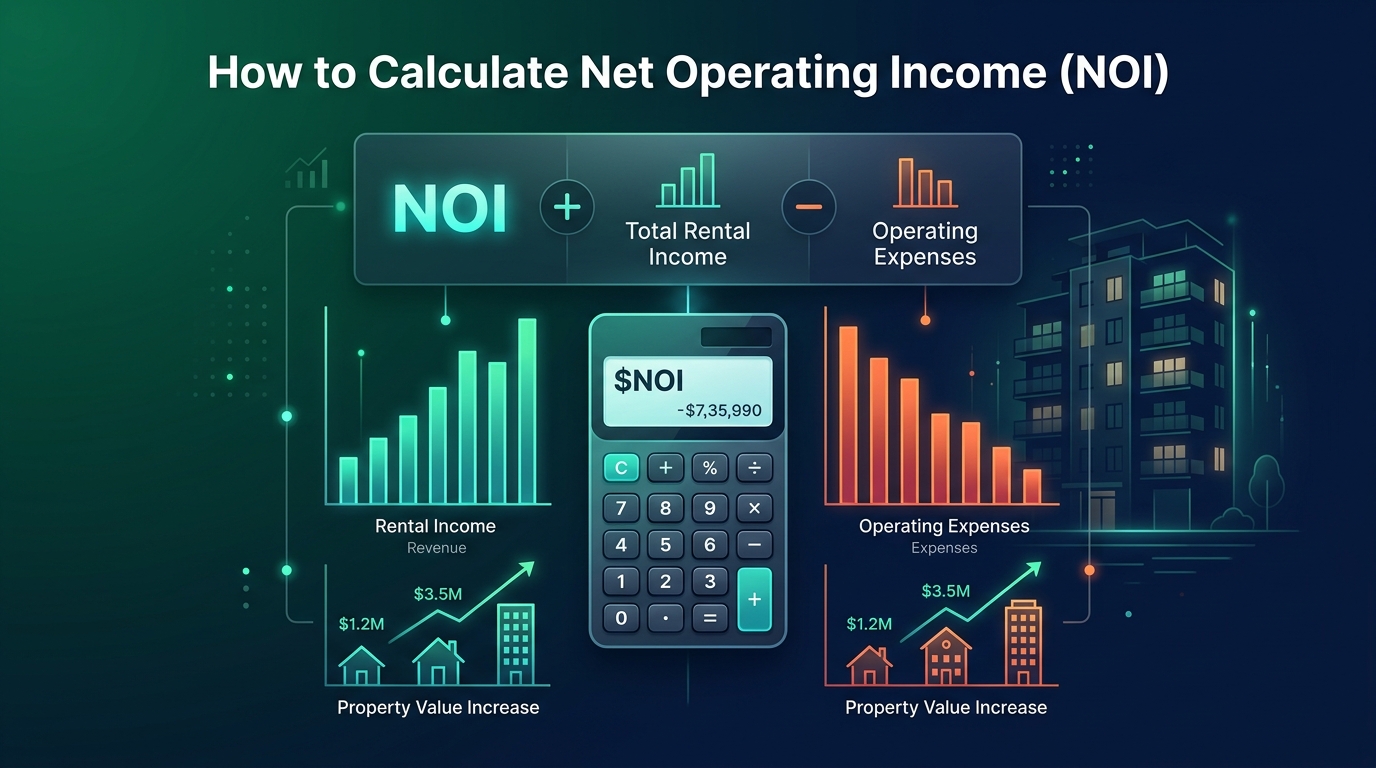
Net Operating Income — NOI — is the single most important number in rental property investing. It drives cap rate calculations, determines property value in commercial real estate, and tells you whether a deal pencils out before you ever talk to a lender. Here's exactly how to calculate it and what pitfalls to avoid.
The NOI Formula
NOI = Gross Rental Income − Vacancy Loss − Operating Expenses
That's it. Two subtractions. The complexity is in knowing what belongs in each bucket — and what doesn't.
Step 1: Calculate Gross Rental Income
Start with the total rent you'd collect if every unit were occupied and paying full market rent. For a 4-unit building with units renting at $1,400, $1,450, $1,400, and $1,500 per month, gross scheduled income is:
($1,400 + $1,450 + $1,400 + $1,500) × 12 = $69,000/year
Add any other recurring income: laundry machines, parking fees, storage unit rentals, pet fees. These belong in gross income too.
Step 2: Subtract Vacancy and Credit Loss
No property is 100% occupied 100% of the time. A standard allowance is 5–8% of gross income for residential properties in stable markets. In high-turnover or transitional markets, use 10%.
For our example at 6%: $69,000 × 0.06 = $4,140 vacancy allowance
Effective Gross Income = $69,000 − $4,140 = $64,860
Step 3: Subtract Operating Expenses
Operating expenses are the costs to run the property — not the financing costs. This distinction matters enormously. Common operating expenses include:
- Property taxes: Use the actual annual bill, not the seller's number (reassessment at purchase often raises taxes)
- Insurance: Landlord/dwelling policy, liability umbrella if applicable
- Property management: Typically 8–10% of collected rent if you hire a PM; your time cost if self-managing
- Maintenance and repairs: Budget 1–1.5% of property value per year for older properties, 0.5–1% for newer
- Capital expenditure reserve: Set aside 5–10% of gross income for roof, HVAC, appliances — even if you don't spend it every year
- Utilities: Only if landlord-paid (water/sewer for multi-family is common)
- Landscaping, snow removal, pest control
- Accounting and legal fees
What Does NOT Go in Operating Expenses
- Mortgage payments (principal + interest) — financing is not an operating expense
- Depreciation — a non-cash tax deduction, not a real operating cost
- Income taxes
- Capital improvements (a new roof is not a repair; it's capitalized)
Worked Example: 4-Unit Building
- Effective Gross Income: $64,860
- Property taxes: $7,200
- Insurance: $2,400
- Property management (9%): $5,837
- Maintenance reserve (1% of $380,000 value): $3,800
- CapEx reserve (7% of EGI): $4,540
- Water/sewer (landlord-paid): $2,400
- Total Operating Expenses: $26,177
NOI = $64,860 − $26,177 = $38,683
How NOI Connects to Cap Rate
Once you know your NOI, you can calculate your cap rate. The formula is simple: Cap Rate = NOI ÷ Property Value
If the same building is listed at $540,000: Cap Rate = $38,683 ÷ $540,000 = 7.2%
You can also run it backwards to value a property: if market cap rates for this asset class and neighborhood are 6.5%, the property's market value implied by its NOI is $38,683 ÷ 0.065 = $595,123. This is how commercial appraisers work.
Common Mistakes That Inflate NOI
- No vacancy allowance: Sellers often present "pro forma" numbers with 100% occupancy. Always apply a vacancy factor.
- Using asking rent, not market rent: Long-term tenants paying below-market artificially suppress NOI. But also beware sellers inflating rent rolls.
- Ignoring CapEx reserves: The building will need a roof eventually. If you don't budget for it, you're borrowing from future-you.
- Using current tax bill: Property taxes often reset at sale in many states. Get an estimate of post-purchase taxes from your county assessor.
Track NOI Automatically
RentrIQ calculates NOI by property and across your entire portfolio in real time — pulling income from recorded payments and expenses from your accounting ledger. You can see monthly and trailing-12-month NOI without touching a spreadsheet.
Bottom Line
NOI is the foundation of every real estate investment decision. Calculate it conservatively — use real vacancy rates, full maintenance reserves, and realistic management costs. A deal that only works at 100% occupancy with no repairs is not a good deal. Build your NOI on assumptions you can defend, and you'll make better investment decisions every time.
Manage your rentals with RentrIQ
Free with unlimited units. Tenant screening, online rent collection, maintenance tracking, and more.
Start Free