Tenant Communication Workflow Guide for Landlords
Discover the tenant communication workflow guide for landlords. Improve tenant satisfaction, boost renewals, and streamline maintenance processes.
Tenant Communication Workflow Guide for Landlords

A tenant communication workflow is a coordinated, multi-channel messaging process that keeps tenants informed at every stage of their lease lifecycle. Property managers who build structured workflows see higher renewal rates, fewer disputes, and faster maintenance resolution. 90% of renters want digital rental processes, and 61% already pay rent online. That shift makes a documented communication process a baseline requirement, not a bonus feature. This tenant communication workflow guide covers the tools, lifecycle sequences, escalation rules, and performance metrics you need to run a professional operation in 2026.
What does a tenant communication workflow guide cover?
A tenant communication workflow is the industry term for what property managers also call a “resident communication SOP” (standard operating procedure). Both phrases describe the same thing: a documented, repeatable process for sending the right message, through the right channel, at the right time. The workflow spans the full lease lifecycle, from move-in welcome messages to lease renewal sequences.
The core outcome of a well-built workflow is consistency. Without a documented process, communication fragments across email, text, and spreadsheets, causing missed follow-ups and billing errors. A structured workflow eliminates that fragmentation by centralizing all messages into a single source of truth.

Three foundational prerequisites drive every effective workflow: verified multi-channel contact data, a software platform that supports automation, and defined message sequences for each lease stage. Get all three right, and the rest of the system runs with minimal manual effort.
What tools do you need before building your workflow?
The right software stack determines how far your workflow can scale. At minimum, you need a property management platform with a built-in tenant portal, an automated messaging engine, and support for at least two contact channels (email and SMS).
| Tool category | Primary function | Business impact |
|---|---|---|
| Property management platform | Centralizes lease data, payments, and maintenance | Single source of truth for all tenant records |
| Automated messaging engine | Triggers timed messages based on lease events | Reduces manual follow-up by staff |
| Tenant self-service portal | Lets tenants submit requests and view documents | Cuts inbound call volume |
| SMS opt-in management | Captures consent per NARPM guidelines | Keeps you compliant and deliverable |
| Contact verification tool | Flags bounced emails and invalid numbers | Maintains data accuracy over time |
Contact data quality is the most overlooked prerequisite. Multi-channel automated communication achieves 98–100% delivery rates, compared to 64–71% for single-channel manual methods. That gap exists almost entirely because of bad contact data and channel limitations. Audit your tenant records every quarter: remove bounced emails, confirm SMS opt-in status, and update emergency contacts.
SMS compliance deserves specific attention. NARPM guidelines require written opt-in consent before sending any automated text messages to tenants. Collect that consent at lease signing and document it in your platform.
Pro Tip: Run a contact data audit before launching any automated sequence. A message sent to a dead email address counts as a missed touchpoint, not a delivered one.
How do you automate tenant communication across the lease lifecycle?
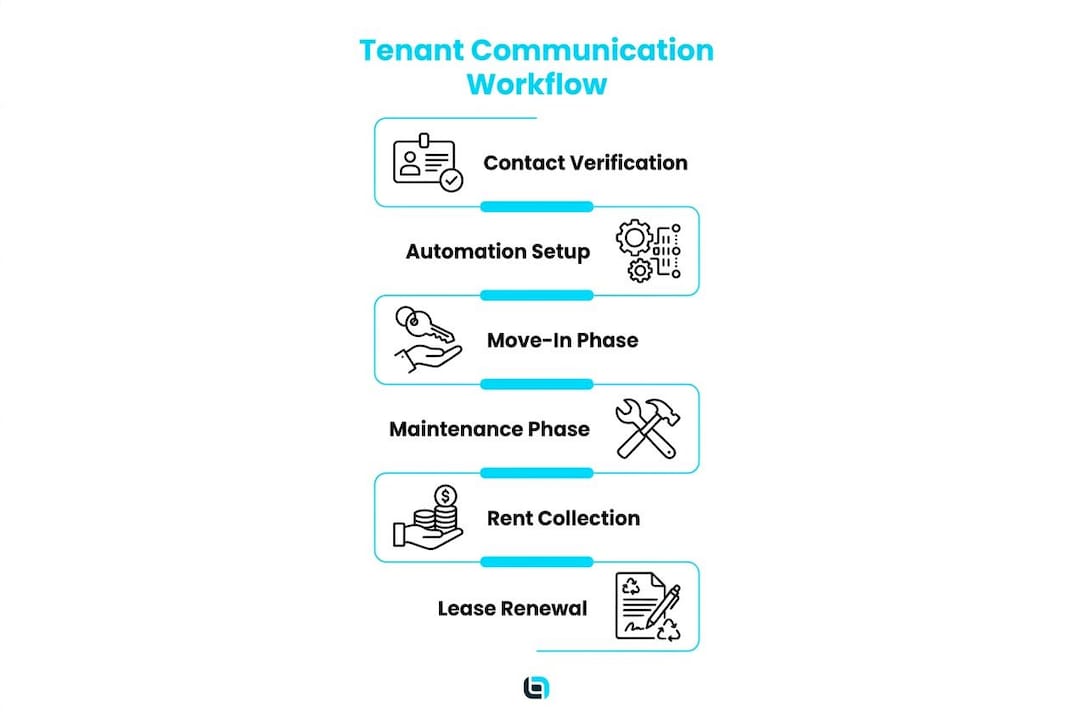
The lease lifecycle breaks into four major communication phases: move-in, maintenance, rent collection, and lease renewal. Each phase needs its own automated sequence with defined triggers, channels, and escalation rules.
Move-in sequence
A structured move-in sequence sets the tone for the entire tenancy. A 7-step move-in communication sequence raises first-year tenant renewal rates by 19%. That number reflects how much a tenant’s first 30 days shapes their long-term satisfaction.
- Day 0 (lease signing): Send a welcome email with the move-in date, key pickup instructions, and a link to the tenant portal.
- Day 1 (move-in day): Send an SMS reminder with the property address and your emergency contact number.
- Day 3: Email utility setup instructions and renter’s insurance requirements. Link to your landlord move-in checklist for reference.
- Day 7: Send a portal registration prompt if the tenant has not logged in yet.
- Day 14: Email a brief satisfaction check: “Is everything working as expected?”
- Day 30: Send a follow-up asking if any maintenance issues need attention.
- Day 45: Deliver a short survey to capture first-impression feedback.
Each step should be automated and triggered by the lease start date. Manual follow-up is only needed if a tenant does not respond to the satisfaction check by day 16.
Maintenance workflow
Automated maintenance communication cuts response times and improves tenant satisfaction. The key is acknowledging every request within minutes, not hours.
- Submission confirmation: Auto-send an SMS and email within 5 minutes of a work order submission.
- Vendor assignment notice: Notify the tenant when a vendor is assigned, including the expected service window.
- Day-before reminder: Send an SMS the evening before the scheduled visit.
- Completion confirmation: Notify the tenant when the work order is marked complete.
- 48-hour satisfaction survey: Ask the tenant to rate the repair quality and vendor professionalism.
Rent collection sequence
Automated rent reminders reduce late payments without requiring you to make awkward phone calls. Send a friendly reminder 5 days before the due date, a due-date confirmation on the first of the month, and a late notice on day 2 if payment has not posted. Escalate to a formal written notice on day 5 per your lease terms.
Lease renewal sequence
A structured 5-touch lease renewal sequence starting 90 days early increases renewal rates to 68%, compared to 52% with manual outreach. That 16-percentage-point difference translates directly into lower vacancy costs.
- Day 90 before expiration: Email a renewal offer with the new rate and lease terms.
- Day 75: Send an SMS follow-up asking if the tenant has questions.
- Day 60: Email a deadline reminder with a link to the digital lease signing portal.
- Day 45: Escalate to a phone call if no response has been received.
- Day 30: Send a final written notice outlining the move-out process if the tenant does not renew.
Pro Tip: Use two channels for every critical touchpoint. If an email goes unread, an SMS often gets the response you need. Reserve phone calls for day-45 escalations and emergencies only.
When should automation hand off to a human?
Automation handles volume. Human judgment handles complexity. The handoff point is where tenant messages carry emotional weight, legal risk, or urgency that a template cannot address.
Define your escalation triggers before you launch any automated sequence. Common situations that require immediate human response include:
- Legal threats: Any message referencing attorneys, housing courts, or formal complaints.
- Safety emergencies: Reports of gas leaks, flooding, fire damage, or break-ins.
- Emotional distress signals: Messages expressing fear, harassment concerns, or mental health crises.
- Repeated unresolved maintenance: A tenant who has submitted the same request three or more times.
- Disputed charges: Any message contesting a fee, deposit deduction, or rent amount.
AI-powered sentiment analysis flags negative tenant messages and accelerates complaint resolution by 55%. That speed matters because unresolved complaints are the leading driver of non-renewals. When your platform flags a high-risk message, route it to a named staff member within one hour and log the resolution in the tenant record.
Every escalated interaction should be documented. Each tenant communication serves as an operational audit point, reducing disputes and improving lease transparency by creating a clear record of unit condition and management responses. That documentation protects you in court and builds trust with tenants who see their concerns taken seriously.
The best property management communication process combines automation for routine touchpoints and personal follow-up for anything that affects a tenant’s safety, finances, or legal standing. Neither alone is sufficient.
How do you measure and improve your workflow over time?
A workflow that never gets reviewed becomes outdated. Track four core KPIs every month: delivery rate by channel, open rate by message type, response rate for satisfaction surveys, and renewal rate by property.
Delivery rate is your baseline health metric. If email delivery drops below 90%, you have a data quality problem. If SMS delivery drops, check your opt-in records and carrier filtering. Fix data issues before adjusting message content.
Open rates tell you whether your subject lines and send times are working. Maintenance confirmation emails typically see the highest open rates because tenants are actively waiting for them. Renewal offer emails often see the lowest, which is why the 5-touch sequence matters.
Renewal rate is the ultimate performance indicator for your workflow for tenant messaging. Track it by property and by lease cohort (tenants who moved in during the same quarter). If one property consistently underperforms, review its communication logs to find gaps in the sequence.
Run a full workflow audit every quarter. Refresh contact data, review bounce reports, update message templates to reflect current lease terms, and check that all automation triggers are firing correctly. A quarterly review takes about two hours and prevents months of silent communication failures.
Operational workflows must centralize messages into a single source of truth to reduce errors and improve accountability.
My honest take on automation and the landlord-tenant relationship
Property managers often ask me whether automation makes tenant relationships feel impersonal. My answer is no, but only if you build the workflow correctly.
The mistake I see most often is using automation as a substitute for accountability rather than a support for it. A landlord who sends 12 automated messages but never responds to a direct question has not built a communication system. They have built a broadcast system. Those are very different things.
Effective tenant engagement is built on respectful, honest, transparent, and personalized communication, not constant contact. That finding aligns with what I have seen in practice. Tenants do not want more messages. They want the right messages, delivered on time, with a clear path to a real person when something goes wrong.
The best workflows I have reviewed treat every automated message as a commitment. If you send a maintenance confirmation saying a vendor will arrive between 10:00 AM and 12:00 PM, and the vendor does not show, your workflow must trigger a follow-up apology and reschedule notice automatically. Failing to do that turns a good system into a trust liability.
Use your workflow as an audit trail in property management. Every logged message is evidence of professional management. That record protects you legally and signals to tenants that you run a serious operation.
The landlords who get the best results are not the ones with the most sophisticated automation. They are the ones who use automation to free up time for the conversations that actually matter.
— Stephen
How Rentriq supports your tenant communication workflow
Rentriq is built for property managers overseeing 10–200 units who need a complete communication and lifecycle management system without enterprise pricing.
The platform includes a self-service tenant portal, digital lease signing, online rent collection via Stripe, and maintenance work order tracking. All tenant interactions log automatically, giving you a complete audit trail for every property. Rentriq’s free property management software lets you start building your workflow today without a long-term commitment. When your portfolio grows, flexible pricing plans scale with you. Property managers who want a structured, documented communication process without building it from scratch will find Rentriq a practical starting point.
FAQ
What is a tenant communication workflow?
A tenant communication workflow is a documented, automated process for sending timed messages to tenants across email, SMS, and portal channels throughout the lease lifecycle. It covers move-in, maintenance, rent collection, and lease renewal touchpoints.
How many channels should a tenant communication workflow use?
Use at least two channels, typically email and SMS. Multi-channel delivery achieves 98–100% delivery rates versus 64–71% for single-channel methods, making dual-channel the minimum standard for professional property management.
When should a landlord intervene manually in an automated workflow?
Manual intervention is required for legal threats, safety emergencies, repeated unresolved maintenance, and any message showing emotional distress. Route these to a named staff member within one hour and document the resolution.
How early should lease renewal communication start?
Start the renewal sequence 90 days before lease expiration. A structured 5-touch sequence beginning at that point raises renewal rates to 68%, compared to 52% with last-minute manual outreach.
How often should you audit your tenant communication workflow?
Run a full audit every quarter. Review contact data accuracy, delivery rates, bounce reports, and automation trigger performance to catch failures before they affect tenant relationships.
Recommended
- How to Screen Tenants: The Complete Landlord Guide (2026) | RentrIQ Blog | RentrIQ
- Landlord Tips & Property Management Guides | RentrIQ Blog | RentrIQ
- Landlord Move-In Checklist: 20 Things to Do Before Your Tenant Arrives | RentrIQ Blog | RentrIQ
- Move-In and Move-Out Inspection Guide for Landlords (With Checklist) | RentrIQ Blog | RentrIQ
Manage your rentals with RentrIQ
Free with unlimited units. Tenant screening, online rent collection, maintenance tracking, and more.
Start Free