Co-Signer Rental Agreement: What You Need to Know
Discover what a co-signer rental agreement is and how it protects both tenants and landlords. Learn the key responsibilities involved.
Co-Signer Rental Agreement: What You Need to Know

A co-signer rental agreement is a lease contract where a third party signs alongside the primary tenant and accepts full legal financial responsibility for the rent and all lease obligations. Under joint and several liability, both the tenant and co-signer are independently responsible for 100% of what the lease requires, not just a proportional share. The landlord can pursue either party for the full amount owed, at any time, without first attempting to collect from the other.
Co-signer agreements typically cover:
- Unpaid rent if the tenant misses or delays payments
- Property damage costs that exceed the security deposit
- Early termination fees and other lease penalties
- Occupancy rights in many leases, meaning the co-signer may legally reside in the unit (unlike a guarantor)
This arrangement comes into play when a renter’s income, credit score, or rental history doesn’t meet the landlord’s screening criteria on its own. A co-signer with stronger finances gives the landlord a legally bound backup, which is often the deciding factor in whether a rental application gets approved.
What are a co-signer’s responsibilities on a rental agreement?
A co-signer takes on the same financial obligations as the primary tenant from the moment the lease is signed. If the tenant misses rent, the landlord can demand full payment from the co-signer immediately, without any obligation to chase the tenant first. That’s not a technicality buried in fine print; it’s the standard structure of co-signer agreements, which routinely waive the landlord’s duty to exhaust collection efforts on the tenant before turning to the co-signer.
The financial exposure goes beyond monthly rent:
- Full rent liability for any missed or late payments by the tenant
- Damage charges beyond the security deposit, including repairs and cleaning
- Lease fees and penalties, such as early termination costs
- Credit impact: late payments reported to credit bureaus affect the co-signer’s score as if the co-signer had defaulted on a personal loan
- Debt-to-income ratio: the lease obligation counts against the co-signer’s borrowing capacity
Most landlords also require co-signers to meet income thresholds, typically requiring an annual gross income of at least 80 times the monthly rent to ensure financial reliability.

How do co-signers and guarantors differ in a lease?
The terms “co-signer” and “guarantor” get used interchangeably in rental conversations, but they carry meaningfully different legal obligations. Understanding the distinction protects you whether you’re the tenant, the person being asked to sign, or the landlord drafting the agreement.
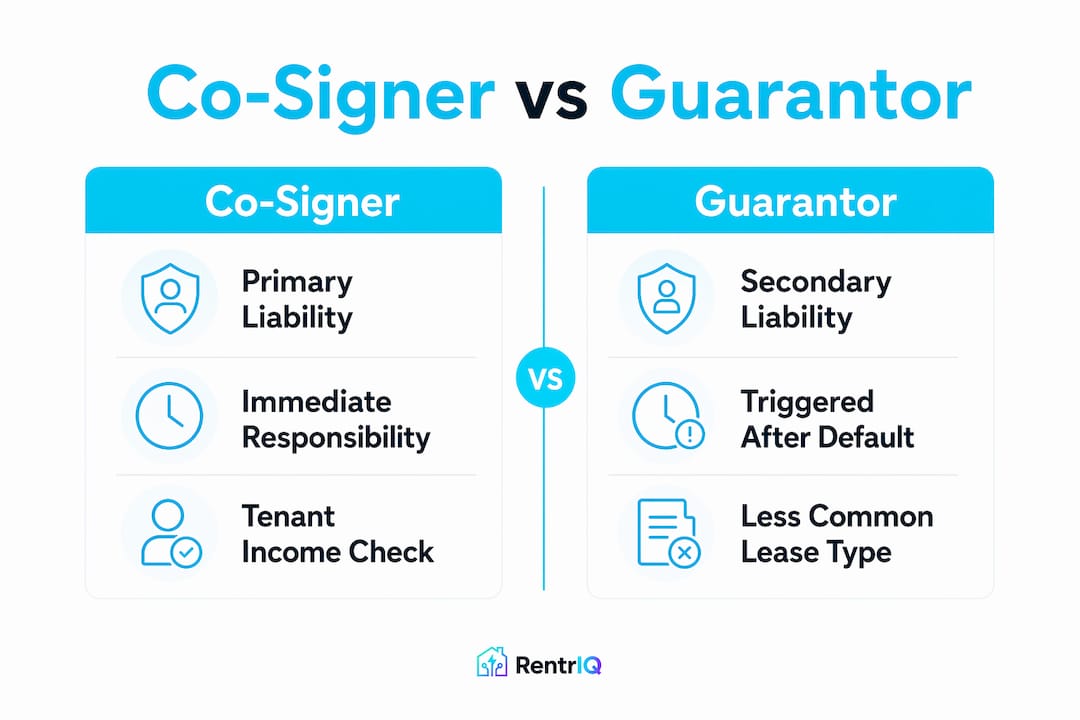
A co-signer shares primary liability from day one. The landlord can demand payment from the co-signer the moment a payment is missed, with no requirement to pursue the tenant first. A guarantor, by contrast, is a secondary backstop: the landlord can only turn to a guarantor after the tenant has defaulted and the landlord has made a genuine attempt to collect from the tenant directly.
Key distinctions at a glance:
| Factor | Co-signer | Guarantor |
|---|---|---|
| Liability start | Day one of the lease | After tenant default and failed collection |
| Landlord can demand payment | Immediately upon default | Only after exhausting tenant collection |
| Occupancy rights | Often yes, per lease terms | Typically no |
| Separate agreement | Usually part of the main lease | Often a separate document |
Most residential leases in the U.S. use co-signer structures rather than true guarantor arrangements. If you’re being asked to sign onto someone’s lease, read the document carefully. The label on the form doesn’t always match the legal obligations in the fine print, as noted by LegalClarity.
Why do renters need a co-signer, and what do landlords require?
Landlords require co-signers when a tenant’s application doesn’t clear standard screening thresholds on its own. The most common triggers are insufficient income, a low credit score, limited rental history, or a high debt-to-income ratio. A co-signer with strong finances gives the landlord a legally bound secondary source of payment, which reduces the risk of approving an otherwise borderline applicant.
Renters typically need a co-signer in these situations:
- First-time renters with no rental history to show
- Students or recent graduates with limited income or credit
- Renters rebuilding credit after financial setbacks
- Self-employed applicants whose income is harder to verify
- Applicants with a high debt-to-income ratio that disqualifies them on income alone
On the co-signer’s side, landlords typically want to see a credit score that meets or exceeds their standard tenant threshold, proof of stable employment, and that 80x annual income benchmark described above. The rental application process for a co-signer mirrors what the primary tenant goes through: income verification, credit check, and sometimes a background check.
What risks should you weigh before agreeing to co-sign a lease?
Co-signing a lease is a financial commitment that can follow you for years. The most direct risk is straightforward: if the tenant stops paying, you pay. But the downstream effects are less obvious and often underestimated.
- Full liability regardless of fault: you owe the full rent even if the tenant simply refuses to pay
- Credit score damage: a single missed payment by the tenant hits your credit report the same way a missed loan payment would
- Extended liability through renewals: co-signer responsibility can carry over automatically into lease renewals unless the lease explicitly limits it
- Reduced borrowing capacity: the lease debt counts against your debt-to-income ratio, which can affect mortgage or loan approvals
- Relationship strain: financial disputes between co-signers and tenants are common, especially when payments are missed
Before signing, review the lease agreement clauses that govern co-signer liability, particularly the duration and renewal terms. If the lease doesn’t explicitly cap your obligation, assume it extends until the tenancy ends.

Expert insights on the financial impact of co-signing
Financial consultants consistently flag one blind spot: co-signers often underestimate how a rental lease affects their own financial profile. The lease obligation appears on your credit report similarly to a loan, and lenders count it against your debt-to-income ratio when evaluating future mortgage or credit applications.
A few points that trip people up:
- Joint and several liability means 100%, not your share: the landlord can hold you responsible for the entire rent amount, not just a portion, even if multiple tenants share the unit
- No waiting period for the landlord: unlike a guarantor arrangement, the landlord doesn’t need to prove the tenant can’t pay before coming after you
- Contribution rights offer some recourse: if you end up covering the tenant’s rent, you have the legal right to pursue the tenant for repayment, but that requires a separate legal action on your part
Pro Tip: Always confirm the duration of your liability before signing. Some leases legally extend co-signer responsibility through automatic renewals. If the addendum doesn’t explicitly cap your obligation to the initial lease term, ask for that language in writing before you sign.
What legal protections do co-signers have?
Co-signers aren’t without rights, even though the structure heavily favors the landlord. Under the legal principle of contribution, if you pay rent or damages that the tenant owed, you have the right to recover those payments from the tenant through civil action. This doesn’t happen automatically; you’d need to pursue it in small claims court or through an attorney.
Co-signers also retain the right to review the full lease before signing and to negotiate specific terms, such as capping liability to the initial lease term or requiring written notice before the landlord demands payment. The FTC’s Credit Practices Rule requires lenders to provide a Notice to Cosigner in consumer credit transactions, outlining what happens if the primary borrower defaults. While this rule applies specifically to consumer loans, it reflects the broader legal principle that co-signers must receive clear disclosure of their obligations before signing.
How do you become a co-signer on a rental lease?
The process is straightforward, but the preparation matters. Landlords treat co-signer applications with the same scrutiny as primary tenant applications.
- Confirm you meet the income threshold: most landlords require annual gross income of at least 80 times the monthly rent
- Check your credit score: you’ll typically need to meet or exceed the landlord’s standard credit requirement
- Gather documentation: pay stubs, tax returns, bank statements, and a government-issued ID are standard
- Review the co-signer addendum: this is either built into the main lease or attached as a separate document; read every clause, especially the duration and renewal terms
- Sign the lease or addendum: most landlords now use electronic signature platforms, so the process is fast once documents are ready
The tenant screening process a landlord runs on a co-signer is nearly identical to what they run on the primary applicant. Expect a credit pull and income verification at minimum.
What alternatives exist to co-signing a rental agreement?
If finding a co-signer isn’t feasible, several alternatives can help a renter qualify without pulling someone else into legal liability.
- Larger security deposit: some landlords accept an additional month’s deposit in lieu of a co-signer, though state law may cap deposit amounts
- Prepaid rent: offering to pay two or three months upfront reduces the landlord’s risk without requiring a third party
- Rental guaranty companies: third-party services act as institutional guarantors for a fee, removing the need for a personal co-signer
- Proof of assets: showing substantial savings or investment accounts can sometimes substitute for income requirements
- Negotiating a shorter lease term: a month-to-month or six-month lease reduces the landlord’s exposure and may lower the bar for approval
Each option has trade-offs. Prepaid rent ties up cash; guaranty companies charge fees. Weigh the cost against the alternative of asking someone you know to take on full legal liability for your lease.
How should you handle disputes involving a co-signer?
Disputes between landlords, tenants, and co-signers usually center on unpaid rent, damage charges, or disagreements about who owes what. Acting quickly and keeping records is the most practical advice.
- Document everything in writing: all communications between the co-signer, tenant, and landlord should be in writing, including payment confirmations and repair requests
- Review the lease and co-signer addendum: the specific language governs who owes what and under what conditions the landlord can pursue each party
- Request an itemized statement: if the landlord claims damages or unpaid rent, ask for a written breakdown before making any payment
- Consult a tenant rights organization or attorney: many states have tenant resource centers that offer free guidance; a local attorney can advise on your specific obligations
- Use move-in and move-out documentation: a thorough move-in and move-out inspection report with photos is the strongest defense against disputed damage charges
If you paid rent on the tenant’s behalf and want to recover it, small claims court is the most practical route for amounts within your state’s filing limit. Keep receipts and bank records as evidence.
Rentriq helps landlords manage co-signer leases with confidence

Managing leases with co-signers means tracking multiple parties, monitoring payment obligations, and keeping documentation airtight. Rentriq’s lease agreement analyzer helps landlords review co-signer clauses, liability terms, and renewal language before a dispute arises. The platform handles digital lease signing, online rent collection, and tenant screening in one place, so nothing falls through the cracks. Start for free at Rentriq and bring the same clarity to every lease you manage.
Key Takeaways
A co-signer rental agreement creates full, immediate legal liability for a third party, covering rent, damages, and fees from the first day of the lease.
| Point | Details |
|---|---|
| Joint and several liability | The landlord can demand 100% of unpaid rent or damages from the co-signer immediately, without pursuing the tenant first. |
| Income requirement | Most landlords require the co-signer to have annual income at least 80 times the monthly rent to qualify. |
| Credit score impact | Missed tenant payments hit the co-signer’s credit report the same way a defaulted loan would. |
| Renewal liability risk | Co-signer responsibility can extend automatically through lease renewals unless the addendum explicitly limits it. |
| Contribution rights | A co-signer who covers the tenant’s rent can pursue legal repayment from the tenant through civil action. |
Recommended
- How to Write a Residential Lease Agreement: 12 Clauses Every Landlord Needs | RentrIQ Blog | RentrIQ
- Move-In and Move-Out Inspection Guide for Landlords (With Checklist) | RentrIQ Blog | RentrIQ
- How to Screen Tenants: The Complete Landlord Guide (2026) | RentrIQ Blog | RentrIQ
- Rental Application Process: A Complete Tenant Guide | RentrIQ Blog
Manage your rentals with RentrIQ
Free with unlimited units. Tenant screening, online rent collection, maintenance tracking, and more.
Start Free