Rental Lifecycle Management: A Complete Guide for Landlords
Discover what rental lifecycle management is and how it maximizes income, reduces vacancies, and simplifies property management for landlords.
Rental Lifecycle Management: A Complete Guide for Landlords

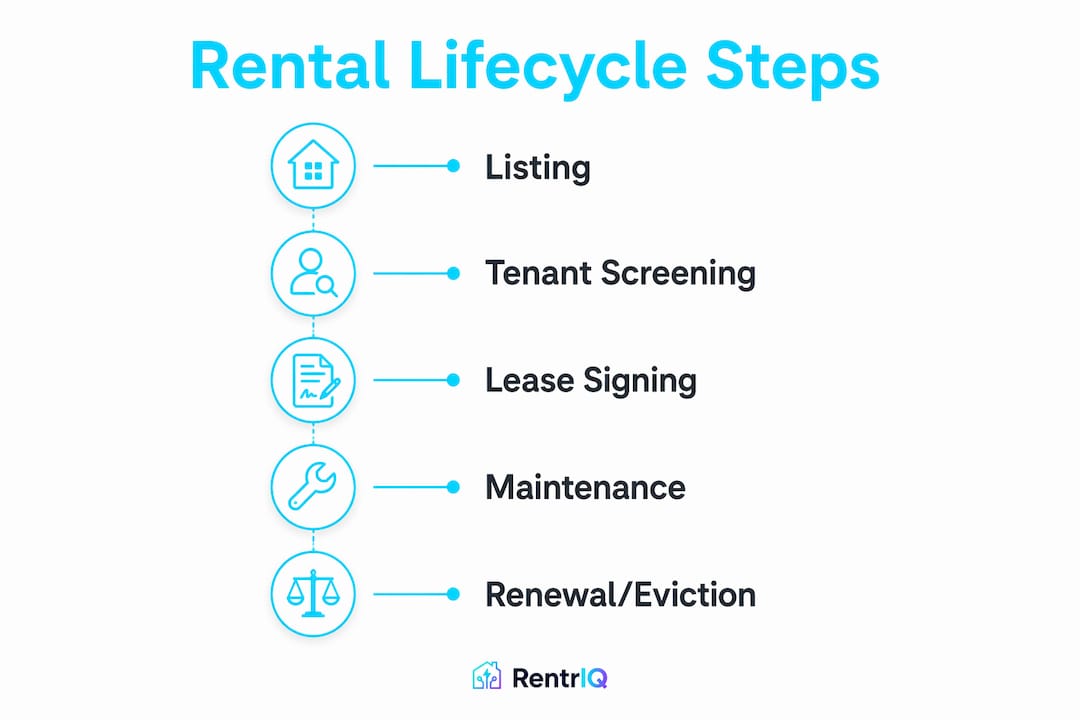
Rental lifecycle management is the end-to-end process of overseeing every stage a rental property moves through, from the moment you list it to the day a tenant hands back the keys and the cycle begins again. The core phases are listing and marketing, tenant screening and leasing, active tenancy management, maintenance, lease renewals, and property turnover. Done well, this process protects your asset value, keeps vacancy periods short, and turns a rental property into a predictable income source rather than a constant fire drill. The rental lifecycle explained simply: every decision you make at one stage directly affects the cost and complexity of the next.
The key components, at a glance:
- Listing and marketing: Preparing the property and attracting qualified applicants
- Leasing and screening: Applications, background checks, and lease execution
- Active tenancy: Rent collection, tenant communication, and day-to-day operations
- Maintenance: Preventive scheduling, repairs, and work order tracking
- Renewals and vacancies: Retention strategies, re-marketing, and eviction procedures when necessary
- Move-out and turnover: Inspections, deposit disposition, and make-ready for the next tenant
- Technology and financial management: Software tools, budgeting, and legal compliance woven through every phase
How to list and market your rental property effectively
Getting a unit rent-ready before you list it is not optional. Prospective tenants form opinions quickly, and a property that shows poorly in photos or during a showing will sit vacant longer, regardless of price. Walk every room with fresh eyes before you photograph it: touch up paint, replace burned-out bulbs, clean carpets, and address any deferred repairs. A property in move-in condition commands stronger applications and gives you negotiating leverage on rent.
For marketing, digital listing platforms give you the widest reach. Syndicating your listing across multiple sites simultaneously shortens the time from vacancy to signed lease. Your listing description should lead with the most competitive features, whether that is a renovated kitchen, in-unit laundry, or proximity to transit, and pair them with high-quality photos taken in natural light.
- Use at least 8–10 photos covering every room, the exterior, and any amenity
- Write a description that answers the questions a qualified tenant would actually ask: square footage, parking, pet policy, utilities included
- Price based on current comparable rentals in your submarket, not last year’s rent roll
- Respond to inquiries within a few hours; slow response rates lose applicants to faster landlords
Pro Tip: Set a consistent showing schedule rather than scheduling one-off tours. Batching showings on the same day creates a sense of demand and lets you compare applicants side by side.
What the leasing process and tenant screening actually require
The leasing workflow has a clear sequence: application, screening, approval, lease signing, and move-in preparation. Skipping or rushing any step creates problems that compound over the entire tenancy. Effective lease management ensures resident retention and maximizes rental income through detailed screening, clear communication, and well-drafted lease agreements.
Tenant screening is where you separate qualified applicants from risky ones. A thorough screen covers:
- Credit check: Look for payment history patterns, not just a score
- Background check: Criminal history relevant to tenancy safety
- Income verification: Gross monthly income should generally be at least three times the monthly rent
- Rental history and references: Prior landlords reveal what a credit report cannot
- Eviction history: A prior eviction is the single strongest predictor of future problems
Apply the same screening criteria to every applicant. Inconsistent standards expose you to Fair Housing Act liability, which the U.S. Department of Housing and Urban Development enforces at the federal level. Document every decision and the reason for it.
Digital lease signing has become standard practice. It creates a timestamped, legally binding record and eliminates the back-and-forth of paper documents. Your lease document management process should include a signed copy delivered to the tenant at execution, not just stored on your end.
Managing active tenancy: maintenance and tenant relations
Active tenancy is not a passive income period. The occupancy phase requires proactive maintenance and genuine tenant engagement to prevent early move-outs and protect your return on investment. A tenant who feels ignored or whose repair requests go unanswered is a tenant who starts looking for another place to live.

Rent collection should run on a fixed schedule with clear late fee policies stated in the lease. Online payment options reduce friction and create an automatic paper trail. For payment reconciliation, match every deposit to its corresponding lease and flag discrepancies immediately rather than letting arrears accumulate.
On the maintenance side, proactive scheduling beats reactive repairs every time. A seasonal inspection program, covering HVAC filters, plumbing, weatherstripping, and smoke detectors, catches small issues before they become expensive ones. When a tenant submits a repair request, acknowledge it the same day and set a realistic completion timeline. Unresolved maintenance is the leading driver of tenant dissatisfaction.
- Use a digital work order system to track every request from submission to completion
- Categorize requests by urgency: emergency (same day), urgent (24–48 hours), routine (within 7 days)
- Keep a vetted vendor list for plumbing, electrical, HVAC, and general repairs
- Conduct a mid-lease walkthrough inspection, with proper notice, to catch unreported issues early
Strong tenant communication practices, including proactive updates on scheduled maintenance and clear channels for reporting issues, directly reduce turnover. Tenants who trust that problems get resolved tend to renew.
How to handle lease renewals, vacancies, and evictions
Lease renewals are the most cost-effective outcome at the end of any tenancy. Every renewal you secure is a vacancy you avoid, and vacancy is expensive in both lost rent and turnover costs. Start the renewal conversation well in advance of lease expiration to give the tenant enough time to decide without pressure, while allowing enough time for re-marketing if needed.

When setting a renewal rent, balance market rate increases against the potential cost of turnover. A moderate increase that retains a reliable tenant can often yield better returns than a larger increase that causes vacancy.
When a tenant does not renew, the vacancy marketing clock starts immediately. Do not wait until the unit is empty to list it. In most states, you can show a unit with proper notice while the current tenant is still in residence.
Evictions are a last resort, but they require strict procedural compliance. The steps vary by state, but the general framework is:
- Serve a written notice (pay or quit, cure or quit, or unconditional quit) per your state’s requirements
- File an unlawful detainer action in the appropriate court if the tenant does not comply
- Attend the hearing with documented evidence: lease, payment records, and all written communications
- Enforce the court order through the sheriff’s office if the tenant does not vacate voluntarily
Missouri’s landlord-tenant law, published by the Missouri Attorney General, is one example of how state-specific procedural rules govern every step of the eviction process. Know your state’s rules before you serve any notice.
Tenant move-out procedures and property turnover management
Move-out is where documentation either protects you or fails you. The move-in condition report is the legal baseline for every security deposit claim. Without a signed, dated, and photographed condition report, landlords cannot legally deduct for damage in 17 states, and courts consistently rule against landlords who lack documented evidence in all states. That single document, completed at move-in, determines what you can recover at move-out.
The move-out process should follow a consistent checklist:
- Schedule the final walkthrough within 24 hours of the tenant vacating
- Compare current condition against the move-in report, room by room, with photos
- Separate chargeable damage from normal wear and tear (scuffed walls are wear and tear; holes in drywall are not)
- Calculate the security deposit disposition and deliver it within your state’s deadline, typically 14–30 days
- Document every deduction with receipts or written repair estimates
After the tenant is out, the make-ready process begins. Prioritize repairs that affect habitability and listing quality first: paint, flooring, cleaning, and any mechanical issues. A structured turnover process with proper checklists and technology reduces vacancy periods and increases profitability. Every day the unit sits vacant after a move-out is a day of lost rent.
Strategic insights that improve rental lifecycle ROI
The national average rental unit turnover rate is approximately 46.9% annually. That means nearly half of all rental units go through the full vacancy-to-occupancy cycle every year. For a property manager overseeing 50 units, that translates to roughly 23 turnovers per year, each one carrying real costs in lost rent, make-ready expenses, and leasing time.
Treating the rental lifecycle as a strategic roadmap rather than a series of disconnected tasks is what separates well-run portfolios from ones that constantly bleed margin. Operational debt accumulates when any lifecycle stage, whether maintenance, lease renewals, or tenant screening, gets neglected. That debt shows up later as deferred repairs, higher vacancy rates, and lower asset value.
Pro Tip: Run an annual property review that scores each lifecycle stage: marketing time, screening-to-lease conversion, maintenance response times, and renewal rates. The stage with the worst score is where your next dollar of process investment will have the highest return.
Technology is the practical lever for managing all of this at scale. A property management platform that connects tenant screening, digital leases, online rent collection, maintenance work orders, and financial reporting in one system eliminates the gaps where tasks fall through. Platforms built for the 10–200 unit range, like Rentriq, give mid-market landlords the operational infrastructure that was previously only available to large enterprise operators.
The financial case for lifecycle discipline is direct. Vacancy periods cost you a percentage of annual rent for every month a unit sits empty. Turnover costs accumulate across make-ready labor, materials, and leasing fees. Retention, driven by proactive maintenance and responsive communication, is the most reliable way to reduce both. Use a rental cash flow calculator to model the difference between a portfolio with average turnover and one with a 10-point improvement in renewal rates. The gap is larger than most landlords expect.
How Rentriq supports the full rental lifecycle
Rentriq is built specifically for property managers and landlords overseeing 10–200 units who need more than a spreadsheet but do not need the complexity or cost of an enterprise platform. The platform covers every phase of the rental lifecycle: tenant screening through SmartMove and Checkr, digital lease signing, online rent collection via Stripe, maintenance work order tracking, insurance management, financial reporting, and a self-service tenant portal for tenants.
If you are managing the full rental lifecycle across multiple units and want a single system that keeps every stage connected, start with Rentriq for free. No long-term contract required.
Key Takeaways
Rental lifecycle management is the single most important operational discipline for landlords who want to protect asset value and generate consistent returns across their portfolio.
| Point | Details |
|---|---|
| Lifecycle stages are connected | A gap in any phase, such as skipped screening or deferred maintenance, creates compounding costs in later stages. |
| Turnover is your biggest financial risk | The national average turnover rate is 46.9% annually; reducing it through retention directly improves annual returns. |
| Move-in documentation is legally critical | Without a signed, dated condition report, landlords cannot legally deduct damages from security deposits in 17 states. |
| Renewals beat vacancies financially | Starting renewal conversations 90 days before lease expiration gives you time to retain tenants or re-market without a gap. |
| Technology closes operational gaps | A connected platform handling screening, leases, rent collection, and maintenance prevents tasks from falling through the cracks. |
Recommended
Manage your rentals with RentrIQ
Free with unlimited units. Tenant screening, online rent collection, maintenance tracking, and more.
Start Free